
The global packaging industry is undergoing its most significant transformation in half a century.Valued at approximately $1.22 trillion in 2026,the sector is no longer just about containing and protecting products.It has become a critical intersection of brand identity,anti-counterfeiting technology, environmental responsibility, and supply chain efficiency.
For procurement managers,brand owners,and packaging designers,the challenge is multifaceted:How do you source materials that captivate consumers at the point of sale,comply with increasingly stringent global regulations,integrate with existing manufacturing processes,and support corporate sustainability goals-all while managing costs?
Yiwu Junchi Packaging Material Firm,an integrated production and trade enterprise based in the global manufacturing hub of Yiwu,China,is addressing this exact challenge.By specializing in high-performance films and papers that blend optical innovation with functional durability,they are positioning themselves as a strategic partner for international brands across electronics,cosmetics, food,and luxury goods.
This blog post provides a comprehensive,data-driven analysis of the key trends shaping the packaging industry in 2026 and beyond.We will explore the market dynamics of sustainable packaging, the rising demand for holographic and anti-counterfeiting technologies,and how Yiwu Junchi’s product engineering aligns with the future of the industry.
1. The Macro View:A $1.4 Trillion Industry in Transition
Before diving into specific materials,it is essential to understand the broader market landscape.The packaging industry is not just growing;it is fundamentally shifting its material priorities.
Global Packaging Market Size and Growth
The numbers paint a picture of steady,resilient growth driven by e-commerce,packaged food demand, and pharmaceutical needs.
Table 1: Global Packaging Market Forecast (2026-2031)
As illustrated,while plastics maintain the largest market share (approximately 41.5% in 2025 ),paper and paperboard are growing at a faster rate.This “material shift” is not an outright replacement of plastic but a strategic transition driven by regulatory bans on single-use plastics and corporate “plastic neutrality” pledges . This creates a unique opportunity for hybrid solutions-such as holographic paper and bio-based films-that offer the best of both worlds.
The E-Commerce Acceleration
A primary driver of packaging demand is the relentless growth of e-commerce.In the United States alone,e-commerce sales for 2024 were estimated at $1.19 trillion,an 8.1% increase from 2023.This surge demands packaging that is not only protective against the rigors of logistics but also lightweight to reduce shipping costs and designed to create an “unboxing experience” that reinforces brand loyalty .
2. The Sustainability Imperative: From Niche to Necessity
Sustainability is no longer a marketing differentiator;it is a license to operate.The market for sustainable packaging is exploding,growing nearly three times faster than the overall packaging market.
Sustainable Packaging Market Dynamics
Table 2: Global Sustainable Packaging Market Growth
| Year | Market Size (USD Billion) | Growth Rate (CAGR) |
|---|---|---|
| 2025 | $399.86 Billion | – |
| 2026 | $440.94 Billion | 10.3% |
| 2030 (Forecast) | $650.9 Billion | 10.2% (2026-2030) |
This rapid expansion is not accidental.It is being forced by two powerful forces:
- Regulation:The European Union’s Packaging and Packaging Waste Regulation (PPWR) is setting a global benchmark,mandating recyclability, minimum recycled content,and strict labeling requirements.In the U.S., proposed legislation like the PACK Act aims to standardize recyclability claims,forcing companies to be more transparent .
- Corporate Commitments:Major brands are embedding sustainability into their core metrics.For example, Estée Lauder reported reaching 71% compliance with its “5 Rs” packaging framework in 2024, demonstrating how premium brands are monetizing sustainability narratives .
How Yiwu Junchi Aligns with Green Trends
Yiwu Junchi’s product development directly addresses these sustainability drivers.Their Holographic Paper is specifically designed to align with global green packaging trends.By utilizing multi-dimensional light-reflective patterns,it achieves a premium visual effect without excessive ink usage.This reduces the chemical load during production and simplifies the recycling process,as heavily inked papers can be difficult to repulp [citation:company data].
Furthermore, while specializing in high-barrier films necessary for product preservation,their focus on precision coating (e.g., the 3-5μm coating on their seamless PET film) means using less material to achieve the same, if not better, performance [citation:company data].This concept of lightweighting-using advanced engineering to reduce material volume-is a cornerstone of sustainable packaging strategy .
3. The Visual & Security Revolution: The Holographic Films Market
While sustainability addresses the “conscience” of a brand,aesthetics and security address its “identity.”In a crowded marketplace,products must stand out instantly,and they must be protected from the $2+ trillion problem of counterfeit goods.
Holographic Films: Small Market, High Impact
Though a niche segment compared to the overall paper and plastic markets,the holographic films sector punches above its weight in strategic importance.
Table 3: Global Holographic Films & Lamination Market (2026-2035)
| Market Segment | 2026 Market Size | 2035 Projected Size | CAGR (2026-2035) |
|---|---|---|---|
| Holographic Films | $0.19 Billion | $0.25 Billion | 3.3% |
| Holographic Lamination Film | $0.18 Billion | $0.25 Billion | 3.5% |
Key Drivers for Growth:
- Anti-Counterfeiting:The primary engine of this market is security.The rising threat of pirated goods across pharmaceuticals,cosmetics,and high-value electronics is driving demand for effective,hard-to-replicate anti-counterfeit technologies.Holographic films provide a visible,verifiable mark of authenticity that is extremely difficult for counterfeiters to duplicate.It is estimated that metallized films and anti-counterfeit solutions will account for over 70% of holographic film market sales in the coming years .
- Brand Differentiation:As noted in the 2026 packaging trends,design is moving away from stark minimalism toward more expressive, brand-rich experiences.Holographic effects-like the 360° seamless patterns offered by Yiwu Junchi create a premium,eye-catching appeal that justifies higher price points in cosmetics and luxury goods.
- Textile and Novelty Applications:Beyond packaging,demand from the textile industry (for glitter and dust) and the gift-wrapping sector is fueling market expansion .
Yiwu Junchi’s Technical Edge in Visual Optics
Yiwu Junchi’s product line is engineered to capitalize on these drivers with precision.
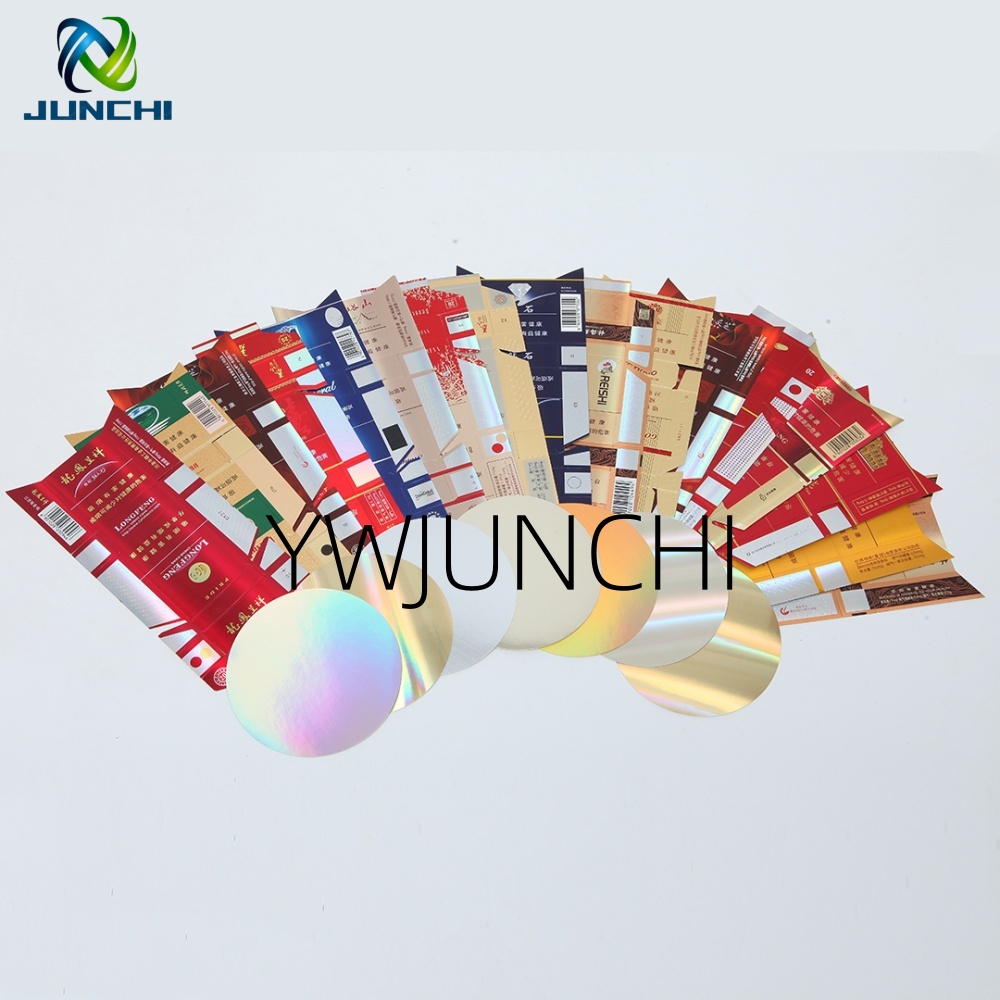
- Seamless PET Holographic Film:This is their flagship product for high-end applications.The “seamless” nature of the 360° holographic effect is critical for luxury branding and cigarette packaging,where pattern interruption is unacceptable.With over 300 customizable designs and a production capacity of 300,000 meters/day,they can serve both bespoke branding needs and large-scale industrial demand.The UV-printable surface ensures that converters can still overprint variable information (like batch numbers or expiry dates) without losing the underlying holographic effect [citation:company data].
- Rainbow Film:Targeting interior decoration and retail displays,this PET based film (0.1mm±0.01mm thickness) offers inherent iridescent colors. Its scratch-resistant surface (≥3H) ensures durability in high-traffic commercial environments,while its compatibility with laser cutting allows for the creation of intricate decorative logos and letters [citation:company data].
4. Application-Specific Engineering: Beyond One-Size-Fits-All
Modern packaging demands specialization.A film suitable for a frozen food bag will fail as a cosmetic box lamination.Yiwu Junchi’s portfolio demonstrates a clear strategy of application-specific engineering.
For Electronics: Robust Protection
The PVC Holographic Film is engineered with the electronics supply chain in mind.It offers moisture resistance,UV protection,and a surface hardness of ≥3H.This protects sensitive components from humidity during ocean freight and from physical abrasion during handling.Its shrinkability also allows for tight,form-fitting wraps that keep out dust and provide shockproof properties [citation:company data].
For Food Preservation: Advanced Barrier Properties
The Metalized Film utilizes advanced Physical Vapor Deposition (PVD) technology to apply an ultra-thin (0.5μm) and uniform aluminum coating.This creates a high barrier against oxygen and moisture-essential for food preservation and extending shelf life.Compared to traditional aluminum foil,this metallized film is significantly lighter and more cost-effective,reducing both material costs and the carbon footprint associated with transportation [citation:company data].
For Pharmaceuticals: The Trust Factor
The pharmaceutical industry,plagued by counterfeit drugs,is a major target for holographic lamination. Holographic films integrated into blister packs or cartons provide an immediate visual cue of authenticity for pharmacists and consumers.The precision of Yiwu Junchi’s embossing,compliant with standards like GBT 23808-2009,ensures that the security feature is consistent and difficult to replicate [citation:company data].
5. The Future:Smart, Circular, and Traceable
Looking ahead, the convergence of the trends discussed will define the next decade of packaging.Yiwu Junchi’s stated vision-focusing on biodegradable materials and smart anti-counterfeiting technologies-places them at the forefront of this evolution.
- Smart Packaging with a Purpose:The future of smart packaging is functional,not just flashy.This includes QR codes or NFC tags that can provide consumers with instant,localized recycling instructions or verify a product’s journey from factory to shelf.It also includes sensors that indicate temperature abuse or spoilage,which is critical for food waste reduction.The high-quality film surfaces produced by Yiwu Junchi provide an excellent substrate for printing and applying these digital identifiers.
- Mono-Material Design for Circularity:One of the biggest challenges in recycling is multi-material laminates (e.g., plastic film glued to paper).The industry is shifting toward mono-material designs (e.g., all-polyethylene or all-paper structures) that are easier to recycle.Yiwu Junchi’s development of holographic paper and high-performance films that can potentially be used in mono-material structures is a critical step.
- Biobased and Alternative Materials:The exploration of materials like mycelium (mushroom roots), algae,and advanced bio-based plastics is accelerating.As these materials move from labs to commercial viability,manufacturers with strong R&D capabilities in coating and laminating,like Yiwu Junchi,will be essential to giving them the functional properties (barrier, sealability, aesthetics) required for real-world packaging.
Conclusion:Partnering for the Future
The packaging material industry is no longer a commodity business.It is a high-stakes arena where visual impact,security,sustainability,and engineering precision must coexist.Yiwu Junchi Packaging Material Firm, with its vertically integrated manufacturing,rigorous quality control (testing for shrinkage, transparency,and adhesive strength),and diverse product range,offers a compelling partnership model for brands navigating this complexity.
By investing in automated production lines and maintaining technical cooperation with institutions like China’s Anti-Static Quality Supervision Center,they ensure that every meter of film-whether it’s a seamless holographic masterpiece for a luxury box or a durable,moisture-proof wrap for electronics-meets the stringent demands of the global market [citation:company data].
As the industry moves toward a future defined by circular economy principles and digital integration,having a supplier that understands both the art of optics and the science of material science is not just an advantage;it is a necessity.
Frequently Asked Questions (FAQ)
Q1: What is the current size of the global packaging market,and how fast is it growing?
A:The global packaging market is estimated to be worth approximately $1.22 trillion in 2026.It is projected to grow at a compound annual growth rate (CAGR) of about 3.42%,reaching around $1.44 trillion by 2031.This growth is primarily fueled by the expansion of e-commerce,the increasing demand for packaged foods and beverages,and the pharmaceutical sector .
Q2: Why is there so much focus on “sustainable packaging” right now?
A: The focus is driven by a combination of strict new regulations (like the EU’s PPWR),corporate pledges to reduce plastic waste,and changing consumer preferences.The sustainable packaging market is growing at over 10% annually and is expected to reach $650.9 billion by 2030.Companies are under pressure to prove their packaging is recyclable,contains recycled content,and has a lower overall environmental footprint .
Q3: What are holographic films mainly used for,and why are they important?
A: Holographic films serve two primary purposes: brand enhancement and anti-counterfeiting.They create a striking,premium visual effect that makes products stand out on the shelf. More critically, the complex,micro-embossed patterns are extremely difficult to replicate,making them a powerful tool to protect brands and consumers from counterfeit goods, especially in the pharmaceutical,cosmetics,and electronics industries .