
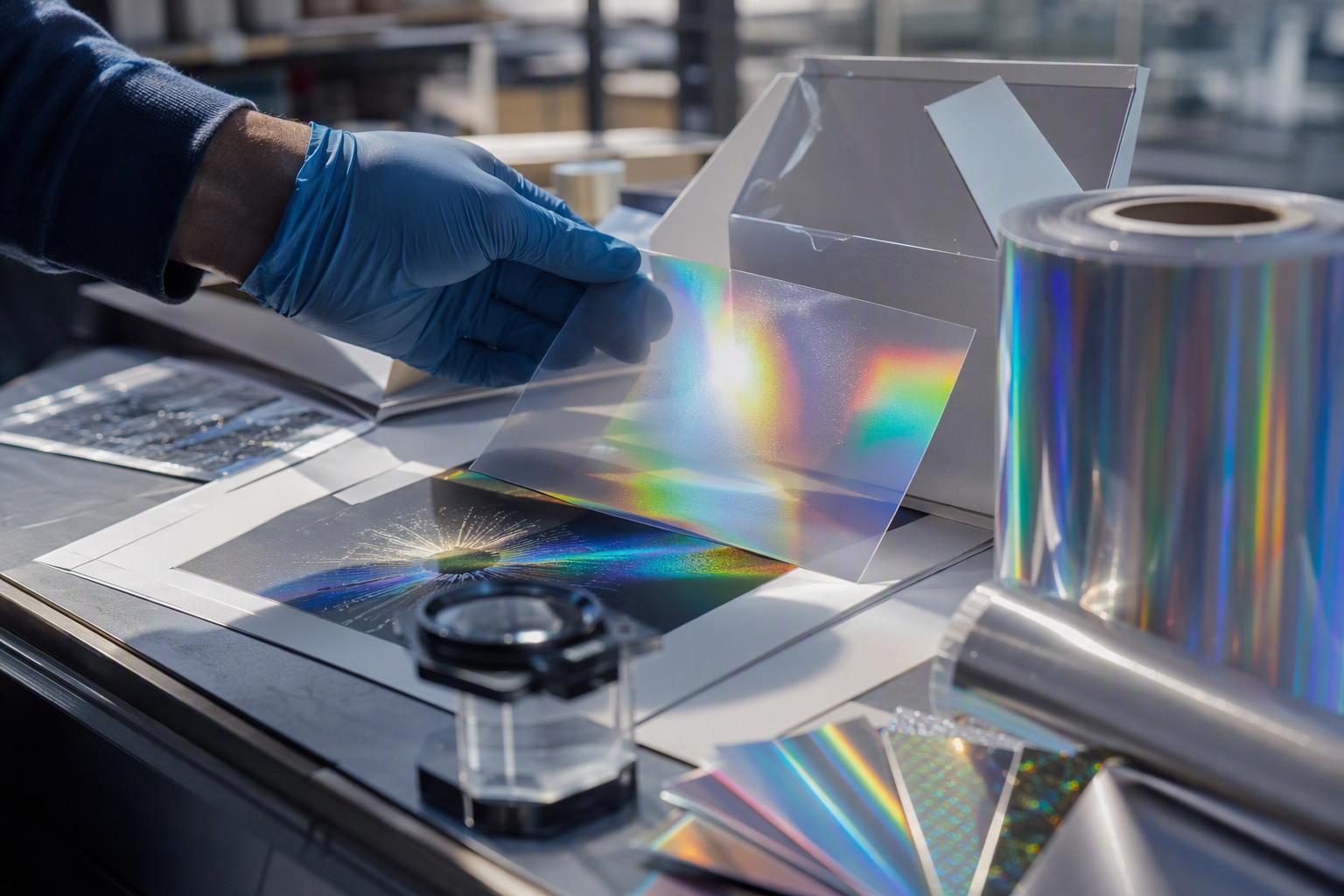
Transparent holographic transfer foil looks different on every substrate, so the sample that sold the concept rarely matches the production run. The same foil that flashes across a white coated board can read as a dull grey haze on kraft, and a proof approved on one press can fail on the next. Getting it wrong costs a press trial, a rejected proof and a re-quoted order, and the delay lands on the launch date rather than the supplier’s invoice.
This guide gives you a four-step sourcing spine: define the process, test the exact substrate, lock the RFQ specifications, and qualify the supplier. Follow it and you end with two documents you can hold a supplier to: an approved press proof and a written spec sheet.
It is built on the two construction patents behind holographic transfer foil, a press manufacturer’s operating manual for die temperature, pressure and dwell, the current ASTM and eCFR editions for test methods and food-contact scope, and recyclability guidance from Nestlé, 4evergreen and RecyClass. Where the evidence stops short, we say so and tell you what to request from the supplier instead.
What is transparent holographic transfer foil and how is it constructed?
Transparent holographic transfer foil is a carrier film coated with a cured relief layer, a semi-transparent reflective layer and an adhesive, and it is the reflective layer that makes “clear” possible. The original holographic hot-stamping foil patent describes the classical route: a surface-relief hologram master is laminated to a polyester film carrier with clear radiation-curable resin, the master is peeled away leaving the cured relief adhered to the carrier, the relief is metallized to raise its reflectivity, and a hot-stamping adhesive is applied (the original holographic hot-stamping foil patent, granted 1990).
The clear variant is a different stack, not a thinner version of the same one. The semi-transparent hologram patent claims a thermally stable carrier, a heat-sensitive release layer, a wear-resistant transparent top coat, an embossable coating, a semi-transparent reflective layer of zinc sulfide, a surface relief pattern, and an adhesive with a tie coat (the semi-transparent hologram patent, granted 1998). The zinc sulfide layer reflects the hologram while letting the print underneath be viewed, which is why the effect changes with ink density and board colour.
“Metallized” therefore covers two chemistries: vacuum aluminium in the hot-stamping patent and zinc sulfide in the semi-transparent one. Ask which one your grade uses before you compare two datasheets.
Terminology matters when you read a quotation. Clear holographic foil is the semi-transparent stack above; holographic transfer film is the same construction sold for pressure or heat transfer rather than a heated die; holographic transfer paper is a finished sheet or board already carrying the transferred layer. A datasheet that names none of these is describing something else.
How is it applied — hot stamping, cold foil or lamination — and on which substrates?
The same manual sets air pressure at 50 to 100 PSI with 60 PSI for setup, and offers dwell timers from 0.2 to 10 seconds depending on the model, while stating that proper dwell information should come from the roll-leaf manufacturer.
That division of labour is the practical point. The press tells you what the machine can hold; only the foil supplier can tell you where a holographic hot stamping foil actually releases. Treat any quoted temperature as a starting point for a trial, never as an approved setting.
Substrate fit has to be proven, not assumed. Coated cartonboard and art paper are the common case, and one supplier quotes a release window of 100 °C to 160 °C for them, which sits inside the press envelope but is that supplier’s figure for its own grades, not an industry window. For polyethylene and polypropylene film substrates, surface energy is the check, measured as wetting tension to ASTM D2578, which is stated as equivalent to ISO 8296 (ASTM D2578-23). That method is scoped to PE and PP film and does not apply to paper or board.
Cold foil and lamination change the risk profile rather than removing it. Cold foil transfers with adhesive and cures under UV, so the heat window disappears but the adhesive becomes the variable. Lamination bonds a holographic film to the sheet, which is a different structure with different end-of-life behaviour, covered in the comparison below.
Which specifications and test methods belong in the RFQ?
An RFQ for transparent holographic transfer foil should specify the construction, the application window, the optical targets and the adhesion criterion, each against a named test method, because no published datasheet combines carrier gauge, adhesive type, activation window and shelf life in one document. Ask for those four per grade in writing.
RFQ field | What to ask for | Reference or method |
|---|---|---|
Carrier | PET gauge in µm, and whether the grade is packaging or heavy-duty | Supplier nominal; state it, do not assume a standard |
Layer stack | Reflective layer chemistry (aluminium or zinc sulfide), top coat, adhesive type | Construction patents as the vocabulary |
Application window | Die temperature range, pressure, dwell, die material | Press manual envelope plus supplier release data |
Adhesion | Tape-test rating after transfer on your substrate | ASTM D3359-23, Method B, 0 to 5 scale |
Clarity | Haze and luminous transmittance of the transferred layer | ASTM D1003-21 |
グロス | Specular gloss at a stated geometry | ASTM D523-25, 20°, 60° or 85° |
Runnability | Static and kinetic COF, with direction and counterface | ASTM D1894-24 |
Film substrates only | Wetting tension of the PE or PP surface | ASTM D2578-23 |
Order profile | MOQ, roll width and length, core size, lead time | Supplier quotation |
Two of these need a caveat written into the RFQ itself. ASTM D3359-23 rates adhesion on a 0 to 5 scale and states that it is “insensitive to all but large differences in adhesion”, so it is a pass/fail gate, not a bond-strength measurement (ASTM D3359-23). ASTM D1003-21 classes material above 30% haze as diffusing, which gives you a defensible line between “clear” and “hazy” instead of an argument about appearance (ASTM D1003-21).
Gloss numbers are meaningless without geometry, so require the angle in the same line as the value. ASTM D523-25 measures specular gloss at 60°, 20° and 85° against a black glass standard, and a figure quoted at 60° cannot be compared with one quoted at 20° (ASTM D523-25).
How does it compare with laminated holographic film and opaque hot/cold stamping foils?
Transfer foil, laminated holographic film and opaque stamping foils differ in structure, in what the print underneath can do, and in how the pack behaves at end of life, so the choice is a design decision rather than a price comparison. The table sets out what each option gives you and what it costs you.
Criterion | Transparent transfer foil | Laminated holographic film | Opaque hot or cold stamping foil |
|---|---|---|---|
Structure | Carrier, relief layer, semi-transparent reflective layer, adhesive | Holographic film bonded to the sheet | Carrier, relief layer, full metallization, adhesive |
Print underneath | Visible through the hologram | Blocked where the film sits | Blocked where the foil sits |
用途 | Heated die or cold adhesive | ラミネーション | Heated die or cold adhesive |
Repulping behaviour | Thin enough to dissipate once transferred | Difficult to separate from paper or board | Thin enough to dissipate once transferred |
Recyclability review | Coverage and substrate decide | Film layer is the issue | Coverage and substrate decide |
The repulping difference is the one buyers most often get wrong. That is a vendor claim about its own products, so treat it as a reason to test rather than a settled fact.
Coverage guidance is where the numbers diverge, and they are not comparable thresholds. The same page reports an SGS repulpability test in which 80% foil coverage did not affect repulpability of a recyclable substrate. Nestlé’s packaging rules take the opposite position for its own packs: limit cold and hot foil stamping on the outside of the pack to premium brands, with a maximum of 30% of the pack surface to avoid sorting or recycling issues (Nestlé’s 30% foil-stamping cap, September 2026 update). One is a repulpability test of one supplier’s product; the other is a brand owner’s design rule. Neither is a legal limit, and Nestlé’s document disclaims itself as non-binding.
The direction of travel is toward design-for-recycling review. 4evergreen’s Version 4 guideline adds a chapter on sorting disruptors and updates compatibility thresholds and advice on adhesives, coatings, inks and barriers (4evergreen’s Version 4 guideline, reported 19 February 2026). RecyClass classifies features as green for full compatibility, yellow for limited and red for non-compatible, and features not yet covered can be tested under its evaluation protocols (RecyClass Design for Recycling Guidelines). Neither document states a numeric foil percentage, so do not let a supplier quote one in their name.
What compliance documentation should a buyer demand?
Compliance documentation for holographic transfer foil depends on where the pack is sold and whether the foil touches food, and the common certificate request is usually the wrong one. A decorative stamped spot on paperboard is not automatically a food-contact coating: 21 CFR 175.300 authorises resinous and polymeric coatings as the food-contact surface, but defines that coating as a continuous film over a metal substrate, or one intended for repeated use that serves as a functional barrier between food and substrate (21 CFR 175.300, eCFR current to 16 October 2026).
For paper and board the relevant route is different. 21 CFR 176.170 covers substances used as components of the uncoated or coated food-contact surface of paper and paperboard for aqueous and fatty foods, including via prior sanction or approval, and dry foods fall under 176.180 instead (21 CFR 176.170). Ask which section your converter is relying on and for which food type.
In the EU, the framework duty is on the material itself. Regulation 1935/2004 requires materials to be manufactured under good manufacturing practice so they do not transfer constituents in quantities that endanger health, cause an unacceptable change in food composition or deteriorate organoleptic properties, and requires a written declaration of compliance where a specific measure applies (EU Framework Regulation 1935/2004, 2004). For plastics, the overall migration limit is 10 mg/dm² of food-contact surface, with 60 mg/kg of food simulant for plastics intended for infants and young children (Regulation 10/2011, 2011).
Four documents to request with every quotation
A written declaration of compliance naming the regulation and the food-contact use it covers
The migration test report behind that declaration, with the laboratory and the test conditions
A statement of which layer contacts food, if any, and whether the foil is behind a barrier
The current ECHA Candidate List status for substances in the adhesive and coatings
Note the limits of what you are being given. The eCFR carries an editorial note that it is not an official legal edition of the CFR, and the ECHA Candidate List count changes, so ask for the version date rather than accepting a number.
How do you qualify a holographic foil supplier and what are the red flags?
Qualify a holographic foil supplier in the order the risk appears: sample consistency first, then order profile, then documentation, then capacity. Start by requesting the same grade from three separate production lots and comparing them on your own substrate, because batch-to-batch variation is what breaks a launch, not a single bad roll.
Order profile is where suppliers diverge most, and the divergence is the finding. One supplier quotes a custom-hologram minimum of 150 m² per design, widths of 8 to 150 mm, 300 m per roll on 1-inch cores, and 1 to 2 weeks for master development (one supplier’s custom-hologram MOQ). A second supplier quotes a stock minimum of 1 roll against 500 rolls per SKU for custom or private-label holograms, widths to 1,280 mm slit to ±0.5 mm, roll lengths from 120 m to 1,200 m, cores of 25.4 or 76.2 mm, and lead times of 7 to 15 days for stock against 20 to 30 days for custom (a second supplier’s quoted order profile, undated). Neither is an industry norm, and averaging them produces a number that fits no supplier.
Red flags, in the order they should stop a conversation:
A quoted temperature or dwell with no grade reference and no offer of a press trial.
An MOQ quoted in a unit your planning system cannot convert, with no roll width, length or core stated.
A compliance certificate with no regulation named, no food-contact use stated and no test report behind it.
A recyclability claim with no coverage figure, no substrate and no test method.
A datasheet that omits carrier gauge, adhesive type, activation window or shelf life, and will not supply them on request.
A sample that arrives from a different lot than the quotation describes.
The last one is worth insisting on. Ask for the lot number on the sample and the lot number on the commercial roll to match, and put that requirement in the purchase order.
What drives total cost of ownership for holographic transfer foil?
Total cost of ownership for holographic transfer foil is driven by yield per roll, trial and proof cycles, and the cost of a recyclability redesign, not by the price per square metre on the quotation. Price per unit is the smallest of those four numbers and the easiest to compare, which is why it wins arguments it should lose.
Yield starts at the foil plant. A single-plant study built on foil manufacturer data records hot stamping foil scrap at 37.7% month-to-date and cold stamping foil at 11.2%, against a plant total of 20.0%, with metallizer creases accounting for more than 50% of accumulated scrap (API Foils plant scrap data, 2019–2020, Kansas State University, 2020). That is manufacturing scrap, not press-side transfer waste, and it comes from one facility over weeks in 2019, so it tells you that crease-driven defects are a real cost in the supply chain rather than giving you a number to apply to your own press.
Press-side waste has no verified figure in the sources reviewed, so treat it qualitatively: carrier take-up, panel gaps and make-ready all consume foil, and a supplier who cannot tell you the panel layout for your artwork is guessing at your yield.
Trial and proof cycles are the second cost. Every substrate change that is not proofed in advance becomes a press trial, and every press trial consumes foil, press time and a proof approval cycle. Testing the exact substrate before the RFQ is the cheapest step in the whole process.
Recyclability redesign is the third and the one that arrives late. If your pack exceeds a brand owner’s foil coverage rule, the fix is artwork, not purchasing, and it lands after the print run is planned. Check the coverage guidance in the comparison section against your own design before the RFQ goes out.
The next step is to request a sample and a spec sheet against your own substrate and press settings, and to talk to a sourcing contact about the order profile your planning system actually needs. Yiwu Junchi Packaging Material Firm supplies holographic transfer foils and will quote against a written specification rather than a catalogue page.
Frequently asked questions
Is transparent holographic transfer foil the same as clear holographic film?
No. Transfer foil is a carrier-borne stack that releases onto the sheet under heat and pressure or adhesive, leaving a thin transferred layer. The two behave differently in a recyclability review.
Can I use one foil grade across coated board, kraft and film?
Only after proofing each substrate. Film substrates add a surface-energy check under ASTM D2578-23 that paper does not need.
What adhesion result should I accept on a proof?
Set the acceptance level in the RFQ before the proof, using ASTM D3359-23 Method B for coatings under 125 µm and its 0 to 5 scale. The standard is explicit that it is insensitive to all but large differences in adhesion, so it confirms a minimum bond strength rather than measuring one (ASTM D3359-23).
Does a food-contact certificate cover a stamped logo on a carton?
Not automatically. 21 CFR 175.300 describes a continuous coating serving as a functional barrier, and a decorative stamped spot on paperboard is not that by itself (21 CFR 175.300). Ask the converter which section and which food type the declaration covers.
Conclusion
The sourcing spine holds: define the process, test the exact substrate, lock the RFQ specifications against named methods, and qualify the supplier on lot consistency and order profile. The evidence supports each step, and it also marks where it stops. The press manual gives a machine envelope and defers to the foil supplier for dwell. The ASTM methods give you defensible adhesion, haze and gloss criteria while being scoped to other materials. The recyclability numbers from a foil maker’s test and a brand owner’s design rule are not comparable thresholds, and neither is law.
What you can hold a supplier to is narrower and more useful than a catalogue claim: a written spec sheet naming carrier gauge, reflective layer chemistry, adhesive type, activation window and shelf life, plus an approved press proof on your own substrate with a lot number that matches the commercial roll. Ask for those two documents and the compliance declaration behind them, and the sample-versus-production gap closes before the order is placed.